Showing posts with label NAFLD. Show all posts

Thursday, October 6, 2011

A molecular biologist serving pizza and fatty liver


Source:  Wikipedia.  I would have had some if it looked this good...

There’s few things more ironic than walking into a lecture titled “the molecular biology of hepatic steatosis” and being met by a table stacked with pizza and soda.  Of course, the molecular biologists in the crowd weren’t the ones with non-alcoholic fatty-liver disease (or NAFLD), but it’s hard to ignore the dissonance.  Fortunately, the talk was better than the lunch offerings.

The lecture was by a medical researcher who investigates the molecular mechanisms behind fatty liver disease.  Today he was highlighting his group’s most recent work on the molecular mechanisms connecting obesity to liver fat deposition.
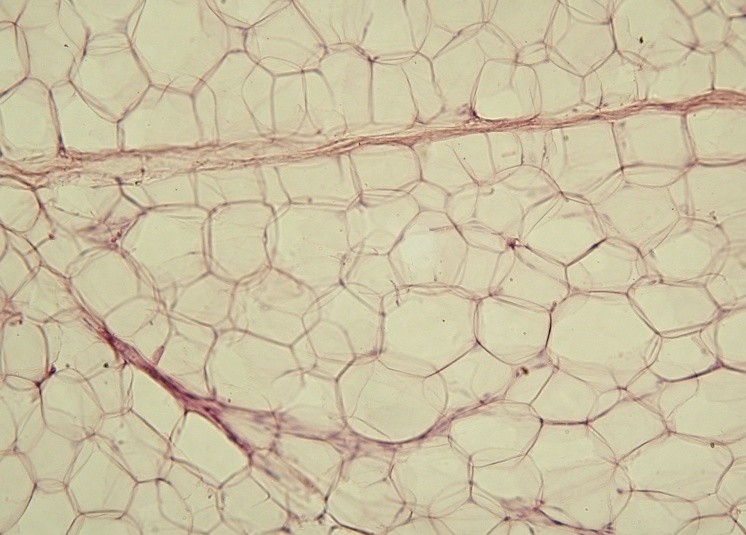
Source: Wikipedia.  Adipocytes (fat cells).

The researcher wanted to address several hypotheses.  The first hypothesis is that when people become obese, their fat cells enlarge (rather than multiply) to a point that induces cellular stress.  This stress then produces a cascade of intracellular signals that tell the fat cell (adipocyte) to begin apoptosis (intentional cell death).  The troubled fat tissue then secretes deleterious cytokines, or hormone-like chemicals.

Source:  Wikipedia.  A Macrophage.

The second hypothesis is that these cytokines recruit immune cells – specifically macrophages, an important cell of the innate immune system – that begin to engulf the fat cells.  The combination of dying fat cells and macrophages causes a big problem.

When fat cells become too large, and start dying off, they dump their fat content into the circulation – like an overstuffed cream-filled donut.  This results in a surplus of free fatty acids floating around the body.  And this is important because two-thirds of the fat in the livers of people with NAFLD are derived from the circulation.  And it isn’t just the adipocytes causing trouble.

Macrophages enjoy company, so they recruit more macrophages by secreting cytokines that have wonderful names such as Tumor Necrosis Factor alpha and Interleukin-6.  These chemicals, and many others, create a vicious cycle whereby inflammation produces more inflammation produces more information.  The inflammation in the fat then appears to spill out into the circulation and reach the liver.
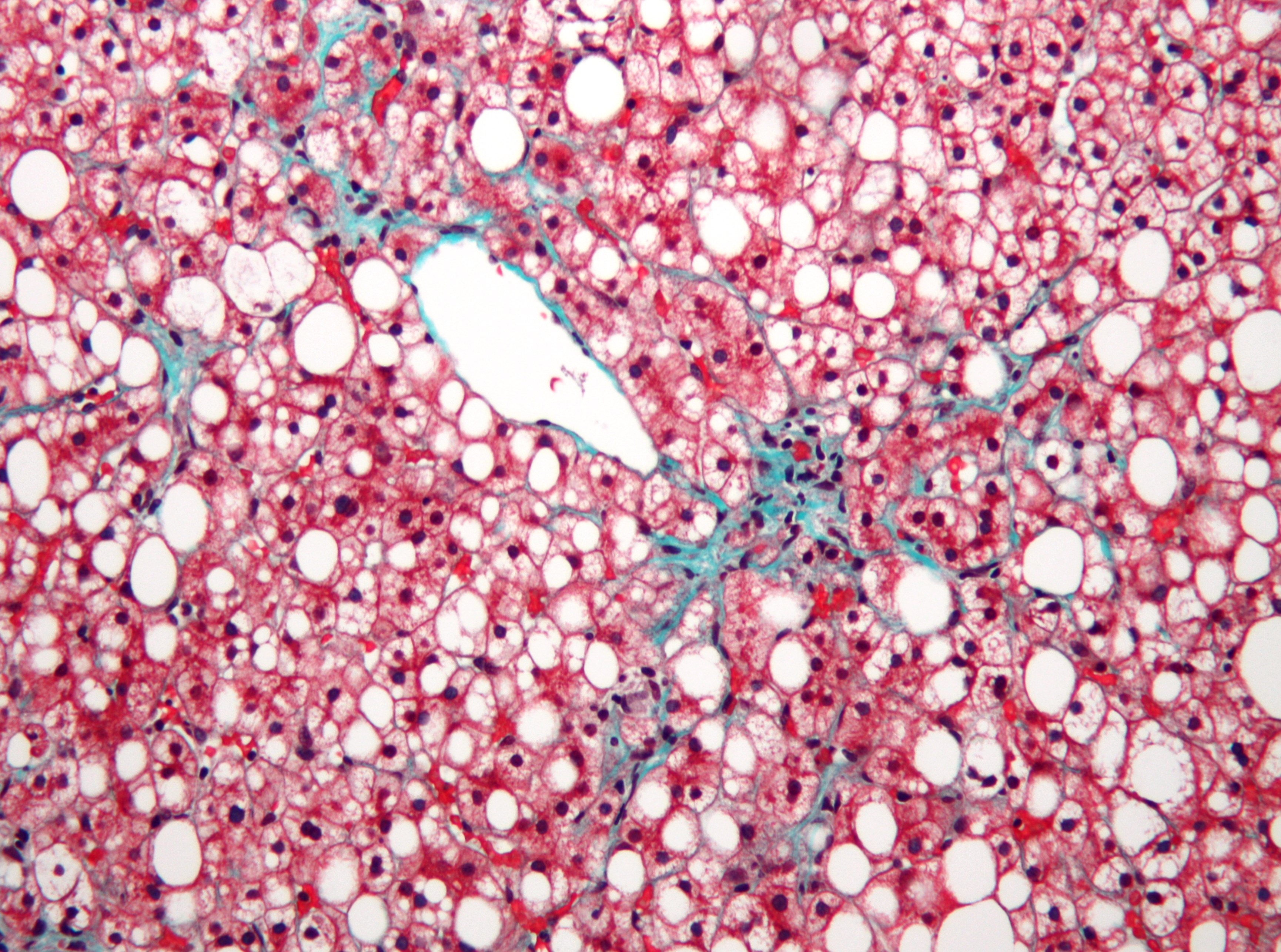
Source: Wikipedia.  Not-alcoholic fatty liver disease.
Liver cells are pink,  the white is fat that shouldn't be there...

Inflammation in the liver leads to dysfunctional fat metabolism.  The liver then begins producing too much fat, which also accumulates in the liver.  The excessive free fatty acids in the circulation and the dysfunctional fat metabolism in the liver account for virtually all of the excess fat seen in NAFLD.  This fat then begets more inflammation.

The excessive fat and inflammation in the liver, and the fat from inflammation, generate a lot of oxidative stress in the liver.  This oxidative stress produces more inflammation, and causes the liver cells to dye off.  This can lead to a clinically inflamed liver (steatosis hepatitis) and even cirrhosis (think alcoholic).  At least, according to the researcher's hypothesis.

The researcher had plenty of data from cell cultures and mice, each experiment clearly showing an increase in relevant proteins and genes in response to diet-induced NAFLD.  He also cited a clinical trial that showed that vitamin E (an anti-oxidant) supplementation was more beneficial than the insulin-sensitizing drug metformin in patients with confirmed NAFLD.  Although, admittedly, the anti-oxidant treatment didn’t seem to be that much of a better treatment.  But perhaps oxidation is indeed the culprit, and Vitamin E just isn’t a strong enough anti-oxidant. 

The obesity to inflammation to fatty liver (and other problems) is a compelling hypothesis, and it has plenty of support in the research community.  If this hypothesis with stands the test of time, then it would support the notion that whatever makes us fat (sugar ‘cough’ and ‘cough’  white flour), probably also leads to insulin resistance, fatty liver, and all the other diseases associated with the Western diet.  But however it goes, I’m still glad that I brought tuna, broccoli, and buttered brown rice instead of chowing down on cheap pizza and soda.

Tuesday, May 17, 2011

High fat diet for a high fat liver

Non-alcholic fatty liver disease (NAFLD) is a consequence of obesity and insulin resistance that is characterized by an accumulation of fatty deposits (triglycerides) in the liver.  This can lead to further insulin resistance, inflammation, and even fibrosis - similar to the damage seen from excessive alcohol consumption, and hence the name.  Under the microscope, a healthy liver is densely packed with magenta hepatocytes (liver cells), while a fatty-liver is infiltrated by white lipid droplets and eventually the blue-green scars of fibrosis.  Paradoxically, at least seemingly, researchers have previously shown that a low-carbohydrate high-fat diet leads to weight loss and reduction of fatty liver, but is the reduction of fatty liver merely a result of the weight loss?

Healthy human liver
Source: Wikipedia

NAFLD liver
Source: Wikipedia


Browning and colleagues conducted a two week trial where two nine-person groups of men and women were either put on a calorie restricted diet (CR) or a low carbohydrate diet (LC).  The CR diet consisted of 1,200 to 1,500 Cal per day.  The LC diet contained no more than 20 grams of carbohydrate per day and the subjects were allowed to eat ad libitum - they did not have to intentionally decrease food intake.  Nuclear magnetic resonance spectroscopy was used to determine the triglyceride content of the subjects' livers before and after the intervention.

Both groups lost a similar amount of weight, eight to ten pounds on average, and both groups showed a reduction in liver fat.   “However, given a similar degree of weight loss, the low-carbohydrate diet resulted in significantly greater intrahepatic triglyceride [liver fat] reduction than did the low-calorie diet” - a 28% reduction in the CR group compared to a 55% reduction in the LC group.  Both groups showed a similar reduction in blood triglycerides with no impact on total cholesterol.  When both groups were combined, a greater reduction in fatty liver content was associated with both lower carbohydrate intake and higher fat intake, and not with protein intake.  Greater fat metabolism, as measured by higher blood ketone levels and lower respiratory quotient, had the strongest association with liver fat reduction.  While it cannot be directly determined from this study, these data are consistent with the notion that a lower carbohydrate intake permits greater fat utilization, which in turn reduces fat sequestered in the liver, and that this is, or at least some of it is, independent of weight loss.

Conceptual representation of associations.
  
Note:  Degree of association and predictive power not to scale.
There is no question that this study has many limitations, especially in regards to therapeutic outcomes.  The study was short and did not measure changes in liver histopathology i.e. fibrosis. But it challenges a popular notion of dietary fat.

Most people on the street believe that eating fat will make you fat.  By extension, they probably expect a high fat diet to induce fatty liver disease, or at the very least, make an already fatty liver worse.  This study turns this idea on it's head - it literally inverts the notion.  While this study only showed that carbohydrate restriction can reduce fatty liver, can eating too many carbohydrates, at least the refined ones, contribute to fatty liver?  History may give us some insight, as excessive carbohydrate feeding has been exploited for centuries to produce the quintessential, albeit controversial, delicacy known as foie gras.

Foie gras - whole liver
Source:  Wikipedia
Foie gras is primarily associated with the French, who indeed hold domain over the name itself.  To produce foie gras, geese are force-fed so that their livers become enlarged and fattened.  This is obviously different from the human case since humans are not force-fed and because geese livers naturally increase fat storage prior to seasonal migration; although geese do not naturally fatten their livers six to ten times that of normal size.  And what is fed to the geese to accomplish this feat?  Refined carbohydrate.

According to Wikipedia (while I'm typically dubious of Wikipedia, this article was well referenced), geese are force fed a "high starch" diet consisting of corn feed.  The feed is sometimes fried in fat to improve digestion.  Furthermore, this practice has ancient roots.  In his encyclopedic work Naturalis Historia, Pliny the Elder, a first century roman intellectual understood "...the same artificial method of increasing the size of the liver of the sow, as of that of the goose; it consists in cramming them with dried figs..."(Perseus Digital Library).  It is probably not a coincidence that the ancient Romans or the French use concentrated fruit sugar or starchy food, respectively, rather than more calorically dense fatty foods such as pure lard or oils, to fatten the livers of geese.  While I am of course extrapolating history to pathophysiology, I am confident the fatty-liver market has optimized the methodology of production.  Fat does not simply beget fat.